


REVERSE ENGINEERING OF A TABLE LAMP
ME 37100: Computer-Aided Design
Spring 2022
Objective
The purpose of this project was to reverse engineer a product with complex curves, which would require the use of advanced design SolidWorks features such as sweep over a 3D path and/or a loft feature to create an accurate model. The object chosen for this project was a table lamp.
Technical Description

Table Lamp
The lamp consists of four main parts the stand, lightbulb attachment, lightbulb, and lampshade. Although the object looked straightforward at first, once it was dissembled to make the measurements, it looked more complex than I initially thought. To simplify SolidWorks' modeling process, I divided the lamp into seven components. The measurements were all done using millimeters because it is a very precise unit of measurement when measuring the smaller intricate features of the lamp. The measurement tools utilized were millimeter scales, vernier caliper, angle measurement ruler, steel wire, clay, camera, and SolidWorks. Multiple measurement tools were utilized simultaneously to measure a part to double-check the measurements. When the object was modeled in SolidWorks, multiple features were utilized, like the loft, sweep, sweep cut, threads, circular pattern, etc.


Freehand sketch of the lamp
Modeling Procedure (Block Diagrams)


Modeling procedure for the components and the final assembly
CAD Model


2D drawing of the components and assembly with dimensions


3D model of components slideshow


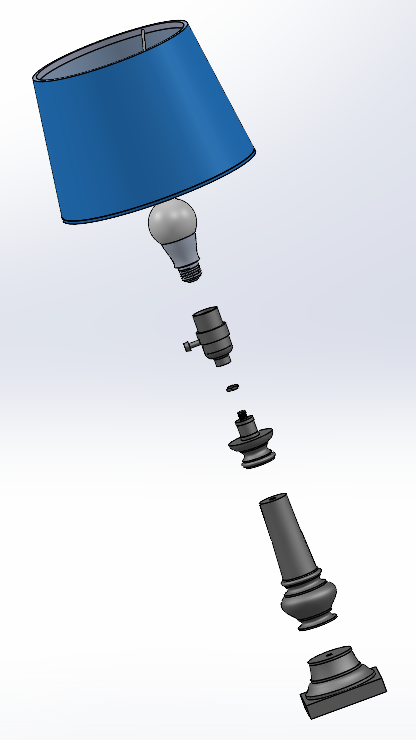
Final assembly slideshow
SolidWorks CAD Files
Results / Outcome
The project was successful in reverse engineering a table lamp with complex geometry. The CAD modeling utilized the use of numerous advanced features on SolidWorks, such as loft, sweep, sweep cut, fillets, revolve, threads, and 3D sketch.